Book Appointment Now
Internal Medicine Training (IMT) in the UK
Author: Dr Ibrahim Elpum
Introduction
Internal Medicine Training (IMT) is the main gateway into medical specialties in the UK, including cardiology, gastroenterology, respiratory medicine, neurology, and many others. It is a highly relevant pathway for UK graduates, IMGs, and doctors aiming for MRCP and higher specialty training. This guide explains IMT clearly and practically, without unnecessary jargon.
What is IMT?
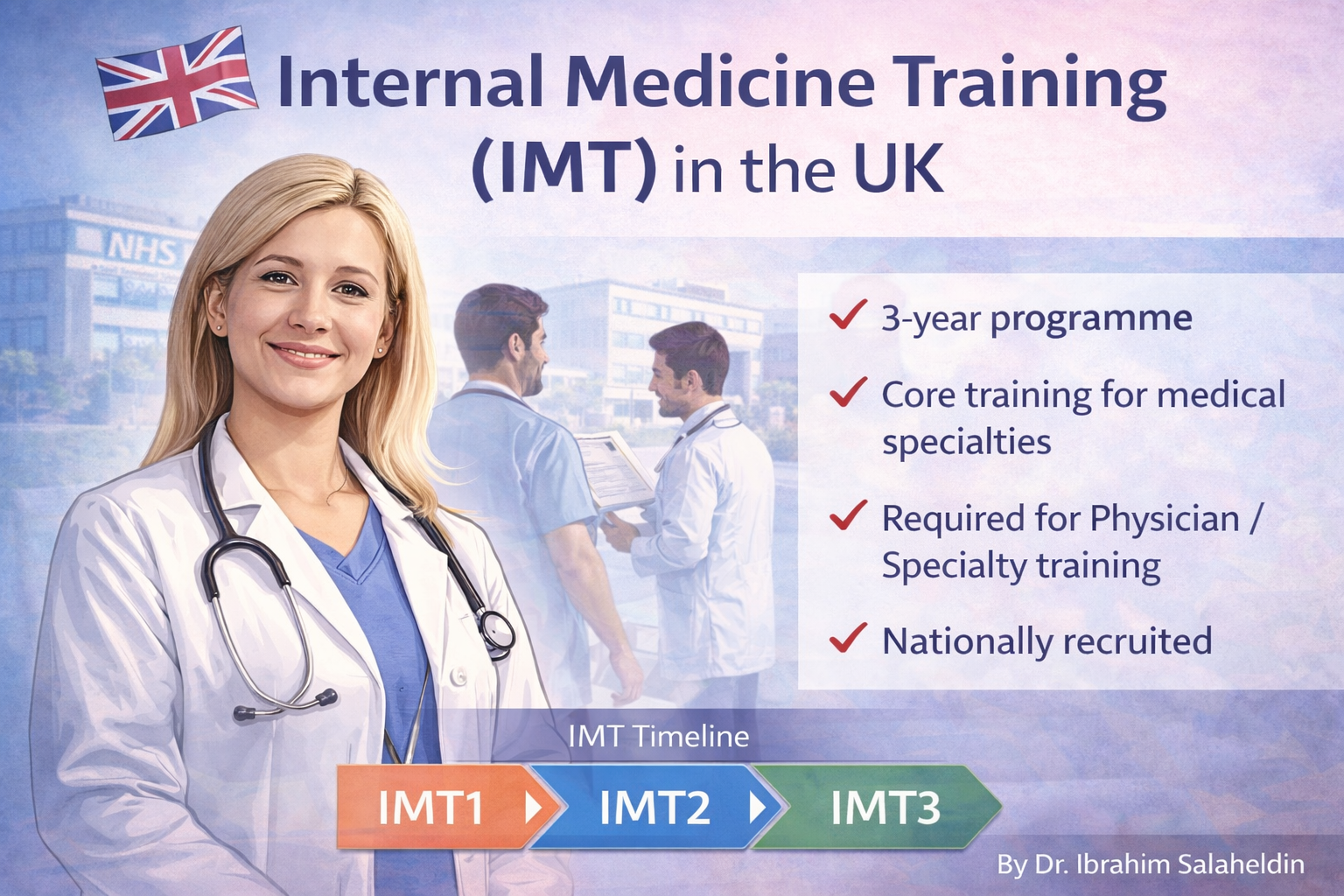
Internal Medicine Training (IMT) is a 3-year postgraduate training programme (IMT1–IMT3) designed to build strong general medical competencies before entering higher specialty training (ST4+).
It replaced the old Core Medical Training (CMT).
If your goal is to become a medical registrar or consultant physician in the UK, IMT is usually essential.
Structure of IMT
- IMT1 – Junior registrar / senior SHO level
- IMT2 – Increasing responsibility, leadership on take
- IMT3 – Medical registrar-level role
By the end of IMT3, doctors are expected to function safely as the medical registrar on-call.
What Specialties Does IMT Lead To?
IMT is the entry route for many competitive specialties, including:
- Cardiology
- Gastroenterology
- Respiratory medicine
- Endocrinology
- Renal medicine
- Neurology
- Rheumatology
- Acute internal medicine
- Infectious diseases
- Geriatrics
If a specialty requires MRCP, it almost always requires IMT completion.
Entry Requirements for IMT
To apply for IMT, you usually need:
- GMC registration
- Evidence of Foundation-level competencies (or CREST form for IMGs)
- Clinical experience in medicine
- Commitment to specialty
- Portfolio evidence (teaching, audit, QIP, presentations, etc.)
MRCP is not required to start IMT, but it becomes essential for progression later.
Life as an IMT Doctor
IMT is demanding but extremely valuable.
Typical responsibilities include:
- Ward rounds and patient reviews
- Leading medical on-calls (especially IMT3)
- Clerking acute admissions
- Escalating sick patients
- Supervising junior doctors
- Procedures (LP, ascitic tap, chest drain, etc.)
- Clinics and specialty exposure
You are no longer just providing service — you are actively being trained to become a registrar-level physician.
Exams During IMT (Very High Yield)
To complete IMT and progress to ST4, you must pass:
- MRCP Part 1
- MRCP Part 2 Written
- PACES
This makes IMT closely linked to MRCP success.
Exam reality:
IMT becomes much easier once MRCP exams are under control.
Portfolio and Assessments in IMT
IMT doctors are assessed using:
- Workplace-based assessments (mini-CEX, CBD, DOPS, etc.)
- Supervised learning events (SLEs)
- Multiple consultant reports (MCR)
- Annual Review of Competence Progression (ARCP)
Your progression depends on consistent engagement, not perfection.
IMT vs Trust Grade Jobs
| Feature | IMT | Trust Grade |
|---|---|---|
| National recruitment | Yes | No |
| Recognised training | Yes | No |
| NTN (training number) | Yes | No |
| Structured teaching | Yes | Variable |
| Leads to ST4 | Yes | Not directly |
| Portfolio required | Yes | Optional but useful |
Many doctors use Trust Grade roles as a stepping stone before applying to IMT.
Common Myths About IMT
- ❌ IMT is only for UK graduates
→ Many successful IMTs are IMGs - ❌ You must have MRCP before applying
→ Helpful, but not mandatory - ❌ IMT guarantees easy consultant job
→ It is a pathway, not a shortcut
Who Should Consider IMT?
IMT is ideal for doctors who:
- Want a career in medical specialties
- Enjoy general medicine
- Are willing to develop leadership skills
- Are working toward MRCP
- Want structured progression toward consultancy
It may be less suitable if you strongly prefer:
- Surgery
- Radiology
- GP
- Non-patient-facing careers
Final Take-Home Message
IMT is not just another training programme — it is the foundation of becoming a UK physician.
It develops:
- Clinical confidence
- Leadership
- Decision-making
- Specialty readiness
If your goal is ST4 and beyond, IMT is the most reliable and recognised route.
Written by Dr Ibrahim Salaheldin