Book Appointment Now
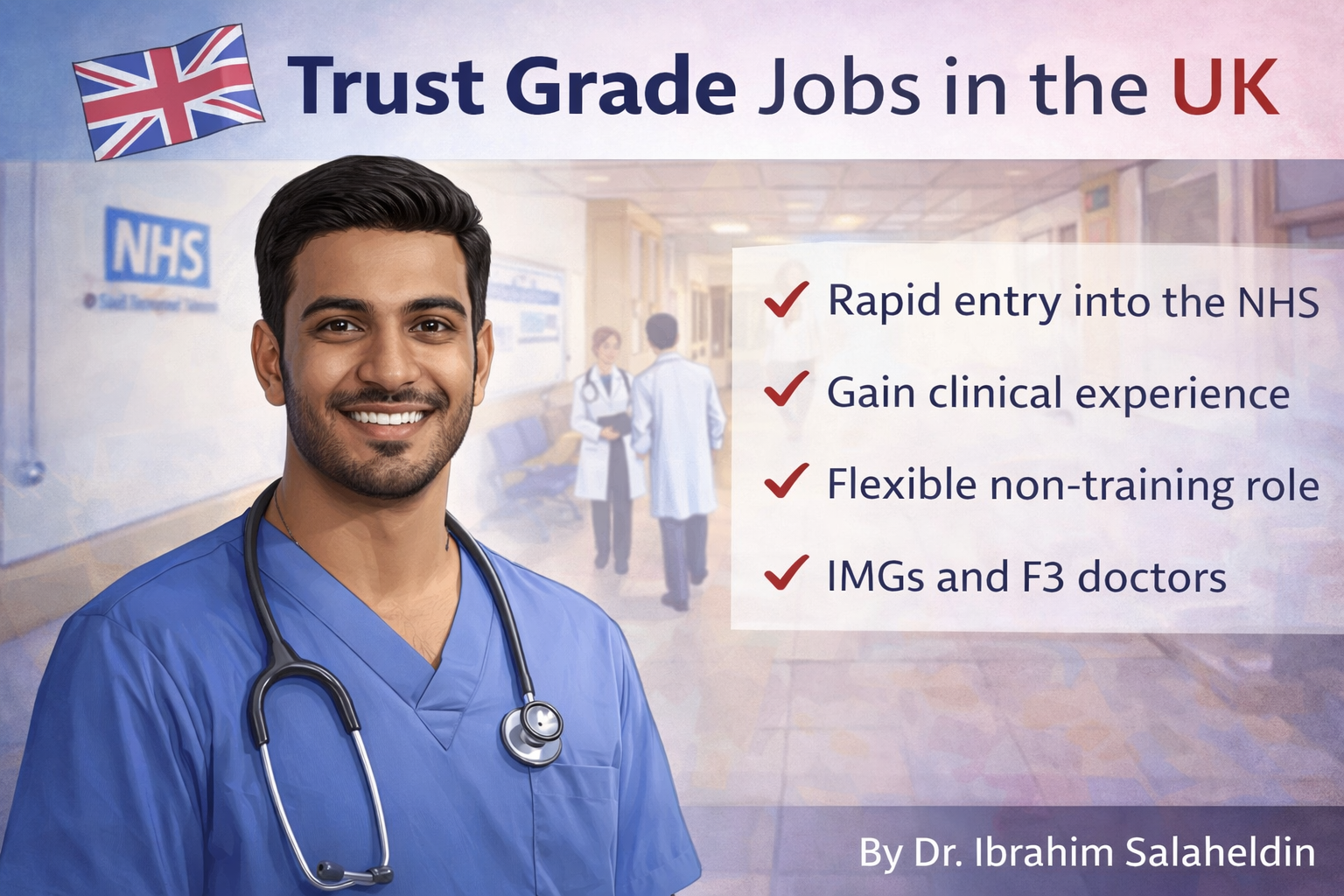
Trust Grade Jobs in the UK
Author: Dr Ibrahim Elpum
Introduction
Trust Grade jobs are one of the most common entry routes into the NHS, particularly for international medical graduates (IMGs) and doctors taking time out of formal training. Despite being widely discussed, they are often misunderstood. This guide provides a clear, practical explanation of what Trust Grade roles are, who they are for, and how they fit into UK medical careers.
What Is a Trust Grade Job?
A Trust Grade doctor (also called Trust Doctor or Locally Employed Doctor – LED) is a doctor employed directly by an NHS Trust, rather than through a national training programme such as Foundation, Core Training, or Specialty Training.
These posts are created to:
- Cover service gaps
- Support rota staffing
- Provide clinical continuity within departments
They are clinical jobs, not observerships, and involve real responsibility and patient care.
Are Trust Grade Jobs Training Posts?
Short answer: No — they are non-training posts.
This means:
- They are not part of the official UK training pathway
- They do not automatically lead to progression like CT or ST posts
- You will not receive a national training number
However, many Trust Grade doctors still:
- Gain excellent clinical experience
- Build strong portfolios
- Successfully move into UK training later
Common Levels of Trust Grade Roles
Trust Grade jobs are usually advertised according to clinical level:
- Trust FY2 / SHO equivalent – suitable for new NHS doctors and IMGs
- Trust CT1–CT2 equivalent – for doctors with some UK experience
- Trust Registrar (SpR) equivalent – for experienced doctors
The title may vary, but the responsibilities usually mirror the equivalent training grade.
Who Are Trust Grade Jobs Best For?
Trust Grade roles are particularly common among:
- International medical graduates entering the NHS for the first time
- Doctors taking an F3 or F4 year after Foundation training
- Doctors who did not obtain a training post in a competitive specialty
- Doctors exploring different specialties before committing to training
For many doctors, a Trust Grade job is a stepping stone, not a dead end.
Typical Duties
Your day-to-day work usually looks very similar to a trainee at the same level:
- Ward rounds
- Clerking admissions
- Reviewing unwell patients
- Requesting and interpreting investigations
- Procedures (e.g. cannulas, LPs, ascitic taps depending on specialty)
- On-calls, weekends, nights
- Documentation and discharge summaries
The difference is not the work — it is the contract structure.
Pros of Trust Grade Jobs
✔ Faster entry into the NHS
Often easier to obtain than training posts, especially for IMGs.
✔ Valuable NHS experience
Helps you understand:
- NHS systems
- Communication style
- Portfolio expectations
- Interview standards
✔ Portfolio building
You can still:
- Do audits and QIPs
- Teach
- Present posters
- Get strong references
All of this strengthens future training applications.
✔ Flexibility
You can change specialty, location, or contract more easily than in formal training.
Cons of Trust Grade Jobs
It is important to be realistic:
- No guaranteed progression
- Less structured teaching than formal training posts
- Study leave and supervision vary between trusts
- You must be proactive in building your portfolio
Success in a Trust Grade role depends largely on how you use the opportunity.
Can You Get into Training After a Trust Grade Job?
Absolutely — and many doctors do.
A strong Trust Grade doctor can build:
- Evidence of clinical competence
- Audit and QIP projects
- Teaching experience
- Supervisor reports
- Good references
These are exactly what UK training programmes look for.
Trust Grade vs Training Post (Simple Comparison)
| Feature | Trust Grade Job | Training Post |
|---|---|---|
| National recruitment | No | Yes |
| NTN (training number) | No | Yes |
| Clinical work | Yes | Yes |
| Portfolio building | Yes | Yes |
| Exams (MRCP, etc.) | You choose | Expected |
| Progression guaranteed | No | Yes |
Common Myth: Trust Grade = Career Failure
This is simply not true.
Many excellent consultants in the NHS today:
- Started as Trust Grade doctors
- Used the time to build strong CVs
- Entered training later with stronger applications
A Trust Grade job is not about your title — it is about what you do with the opportunity.
Final Take-Home Message
Trust Grade jobs are:
- A legitimate and common part of NHS careers
- An excellent entry route for IMGs
- A powerful stepping stone into training if used strategically
With the right mindset, a Trust Grade role can accelerate your career rather than delay it.
Written by Dr Ibrahim Salaheldin